


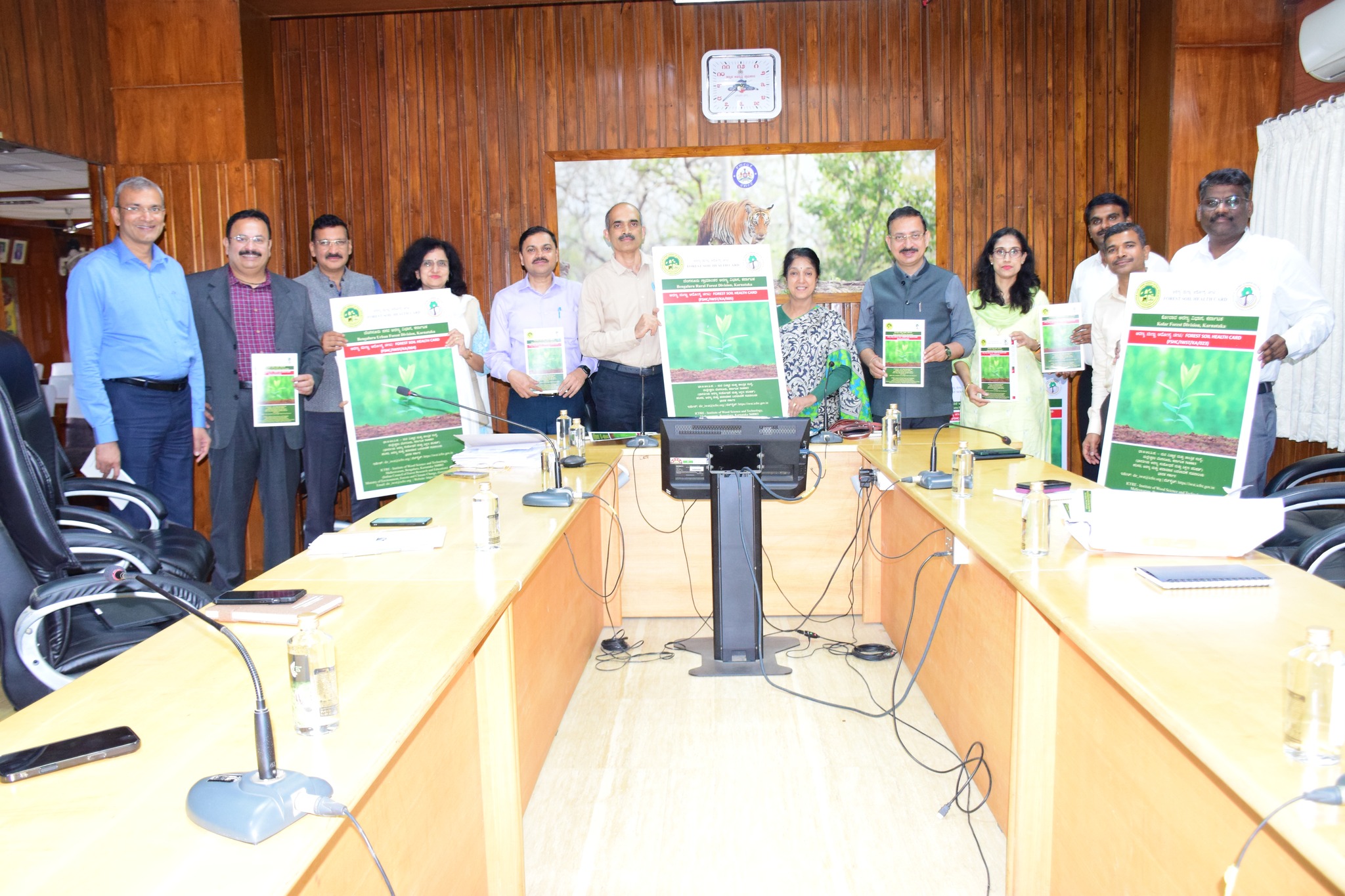


Bengaluru | June 19, 2025 — In a landmark development for sustainable forest management and climate resilience, Forest Soil Health Cards prepared for 40 forest divisions of Karnataka were officially released today by Dr. Meenakshi Negi, IFS, Principal Chief Conservator of Forests and Head of Forest Force (PCCF & HoFF), Karnataka Forest Department. The release event took place at Aranya Bhavan, the state forest headquarters in Bengaluru, and was attended by senior officials, scientists, and forest managers.
The Forest Soil Health Card initiative, spearheaded by the Indian Council of Forestry Research and Education (ICFRE) through its regional research institute, the Institute of Wood Science and Technology (IWST), Bengaluru, marks a first-of-its-kind effort in Karnataka to comprehensively document and evaluate soil health parameters across the state’s forest landscapes. This science-based intervention is set to inform and guide evidence-driven decisions for plantation, regeneration, biodiversity conservation, and carbon sequestration efforts across the state.
Scientific Foundation for Sustainable Forestry
The core objective of the Forest Soil Health Card initiative is to strengthen the scientific basis for forest ecosystem management. Traditionally, forest management decisions — including species selection, site preparation, and nutrient supplementation — have relied heavily on experiential knowledge and visual observations. However, with increasing climate variability and rising expectations from forest landscapes in terms of ecological and economic services, a data-driven approach has become imperative.
Each Forest Soil Health Card developed under this initiative includes a comprehensive analysis of the soil’s physical, chemical, and biological properties. The parameters assessed include:
- Soil pH – indicating soil acidity or alkalinity
- Organic carbon content – a proxy for soil fertility and biological activity
- Nitrogen (N), Phosphorus (P), and Potassium (K) – essential macro-nutrients
- Soil texture and bulk density – influencing water retention and root penetration
- Moisture holding capacity – critical for dry season survival
- Microbial biomass and activity – reflecting biological health of the soil
These soil cards provide a baseline diagnostic for each forest division, enabling forest managers to identify nutrient deficiencies, soil degradation risks, and site-specific interventions required to improve forest productivity and resilience.
Remarks from the PCCF (HoFF)
While releasing the soil health cards, Dr. Meenakshi Negi highlighted the pioneering nature of the initiative and its relevance to emerging challenges in forest governance. “We are now entering a phase where forest management must respond to climate impacts, carbon targets, and ecosystem service expectations. Soil is the foundation of all terrestrial ecosystems, and understanding its condition is central to sustaining our forests in the long run,” she noted.
She congratulated IWST for their scientific rigour and extensive field efforts, which involved the collection and analysis of over 600 samples from a wide range of forest types — including dry deciduous, moist deciduous, evergreen, and scrub forest zones. The cards also take into account altitudinal variation, past land use, and anthropogenic pressures, making them a truly comprehensive management tool.
Methodology and Field Engagement
The soil health card preparation involved a year-long effort by IWST’s team of soil scientists, ecologists, and field researchers. The process began with stratified sampling across the 40 forest divisions, ensuring that each ecological zone, management unit, and soil type was adequately represented.
Sampling plots were geotagged using GPS, and detailed field observations on vegetation, slope, and canopy cover were recorded alongside soil collection. The samples were then analyzed in IWST’s certified laboratory using standard ICFRE protocols.
The output for each division includes:
- A summary table of soil parameters with recommended optimal ranges
- Color-coded ratings for soil quality indicators
- Specific management recommendations (e.g., need for organic matter addition, suitability for particular species, water conservation measures)
- Spatial representation of soil condition across the division
Importantly, the Forest Soil Health Cards are designed to be user-friendly for forest field staff, with visual indicators and a concise explanation of key terms. The cards will be digitized and made available through Karnataka Forest Department’s internal MIS platforms to facilitate integration with ongoing plantation and working plan modules.
Strategic Implications for Forest Management
With the release of these cards, Karnataka Forest Department now possesses a powerful tool to enhance the ecological and economic efficiency of its forestry programs. Some immediate applications include:
- Improved species-site matching: Planting species that are best suited to the local soil conditions will enhance survival rates, reduce input costs, and improve ecosystem service outcomes.
- Informed fertilizer and amendment use: Avoiding blanket application of inputs by using nutrient-specific recommendations, ensuring cost-effectiveness and environmental sustainability.
- Restoration of degraded lands: Identification of severely depleted soils can guide targeted interventions such as mulching, use of green manure, or introduction of mycorrhizal fungi to improve soil fertility.
- Support for carbon projects: Reliable soil carbon baseline data contributes to improved accuracy in ARR (Afforestation, Reforestation, and Revegetation) and ALM (Agroforestry Land Management) carbon credit methodologies.
- Resilience against climate impacts: Soils with better moisture retention and organic matter content are more resilient to droughts and high temperature stress, providing long-term stability to forest ecosystems.
Policy and Programmatic Linkages
This initiative directly supports several national and state-level policy priorities:
- Green India Mission (GIM): The GIM’s focus on ecosystem restoration aligns with soil-based planning for increased vegetation cover and productivity.
- State Action Plan on Climate Change (SAPCC): Soil health data feeds into the climate adaptation and mitigation strategies for forest-dependent regions.
- National Soil Health Program: While originally aimed at agriculture, Karnataka’s forest soil cards extend this principle to non-agricultural landscapes — a first-of-its-kind effort.
- Nationally Determined Contributions (NDCs): India’s forestry-related NDC commitments require enhanced monitoring and reporting systems, which this initiative directly contributes to.
A Model for Other States
Karnataka’s initiative is likely to serve as a model for replication across other forest-rich states in India. By mainstreaming soil diagnostics into forest management, it elevates the conversation from planting targets to ecosystem integrity.
Officials from MoEF&CC and ICFRE present at the release function praised the Karnataka Forest Department’s proactive approach and expressed interest in scaling the methodology across central Indian, Himalayan, and coastal forest landscapes.
The digital integration of these soil health cards with forest planning software, geo-portals, and carbon monitoring systems is also being explored as a next step, potentially offering real-time data integration and dashboard-based tracking for decision-makers.
Conclusion
The release of Forest Soil Health Cards for 40 divisions marks a transformative moment in the way forestry is practiced in Karnataka. By grounding afforestation and restoration decisions in scientific soil diagnostics, the state has taken a definitive step toward sustainable, resilient, and climate-smart forest ecosystems.
As India and the world face increasing pressures from climate change, biodiversity loss, and land degradation, such innovations signal the shift toward forestry that is not only productive but also ecologically informed and future-ready.